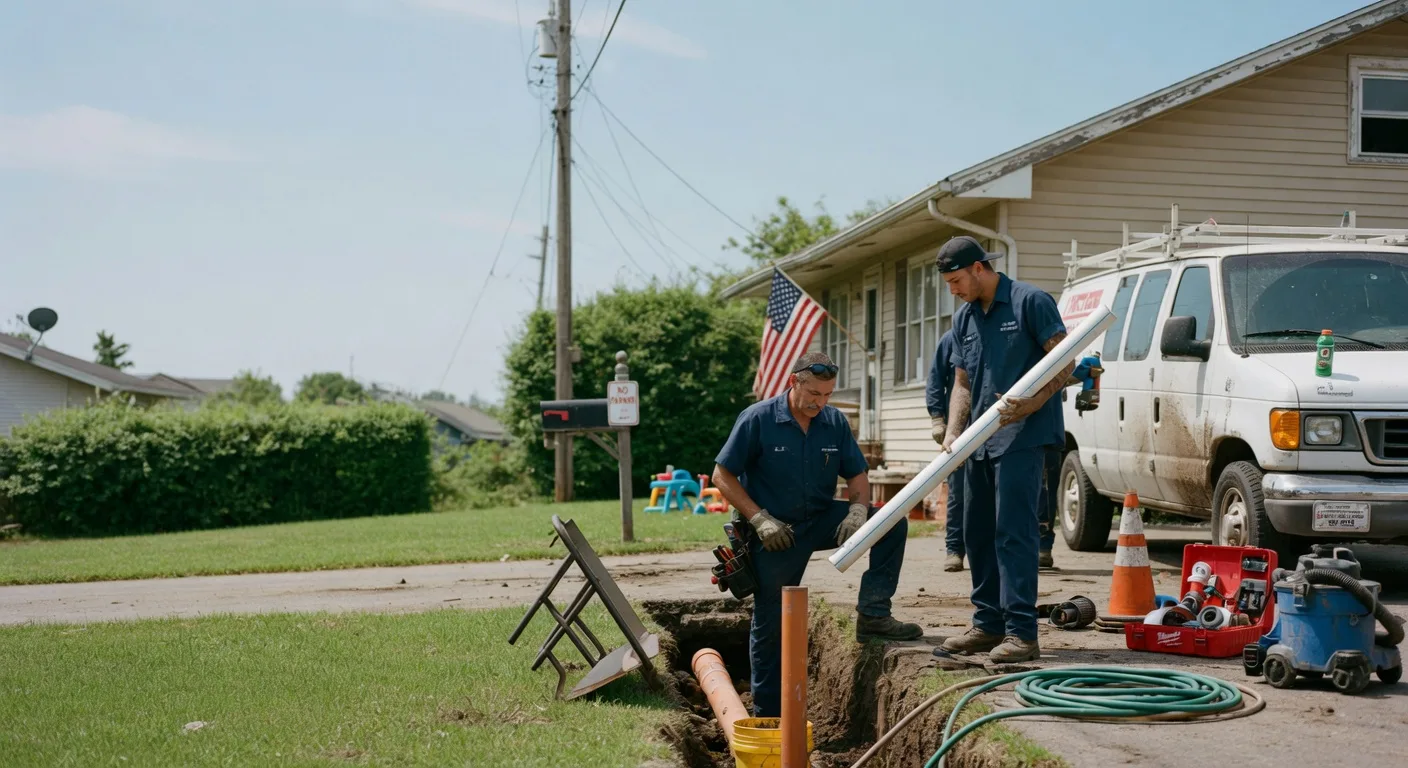
Does a garbage disposal cause drain clogs?
Your kitchen sink is slow and there is a disposal under it, so you suspect the disposal. It can contribute, but the disposal itself is rarely the clog. It chops food into small pieces. It does not make that food disappear, and the pieces still have to travel down the pipe.
Ground scraps mix with grease and settle as grease build-up on the pipe wall, in the trap and in the horizontal run past it. Potato peels, rice, pasta, coffee grounds and fibrous stalks make it worse.
Safe homeowner checks: run cold water and listen for a hum, which means the disposal is jammed. Switch it off at the wall before anything else, and never put a hand inside. See whether the other side of a double sink fills, and whether the dishwasher drains.
Stop running water and call if other fixtures gurgle or back up, if you smell sewage, or if standing water does not drop for hours. One slow kitchen sink points to the branch line. Several fixtures affected points to the main line or a blocked vent stack.
A cable machine is usually enough for a soft clog near the trap. Heavy grease along a longer run calls for hydro jetting. A clog that returns calls for a camera inspection, to look for a bellied line.
Cost depends on access, how long the line is, and what has to be removed. For Drain Cleaning help, call (380) 262-9173. Expert Plumbers Co is a referral service and will refer you to a plumber serving Dayton, ME.
If you do keep a disposal, a few habits cut down on repeat clogs. Run a strong flow of cold water for about half a minute after each use, so the ground waste is carried past the trap and into the larger line instead of settling in the horizontal run. Scrape greasy pans into the trash first, and wipe them with a paper towel before they reach the sink. Citrus peel and ice do nothing for the pipe, so skip the habit of relying on them to clean it. Never use the disposal as a trash can for egg shells, bones, onion skins or artichoke leaves. Tell the plumber how old the unit is and whether the dishwasher drain hose connects to it, because a blocked disposal inlet can back dishwasher water into the machine. In older homes the kitchen line is often a long, shallow-sloped run, which is why grease collects there so easily.
Can I watch the camera footage from my sewer line, and what should I ask the plumber to show me?
Yes, you can ask, and a plumber who does this work properly will usually be glad to show you. The picture is the clearest evidence there is of what is happening inside a pipe you cannot see.
Most inspection cameras feed a small monitor at the cleanout or a tablet held by the plumber. Ask to watch it live. Ask to see the footage again afterward, and whether it was recorded. A recording matters if you later need a second opinion, a repair quote from another plumber, or a record for a home sale.
Here is what to ask to see.
The start of the run. A clean, round pipe wall tells you the line was open and what material it is, such as clay, cast iron or plastic.
Any joint that looks offset, cracked or separated. Ask the plumber to pause on it.
Root growth. Fine roots look like hair or threads at a joint. Heavy roots fill the pipe like rope.
Standing water. A section that holds water is a bellied line, a low spot where debris collects. Ask how long the section is.
Scale or heavy buildup, especially in cast iron, where the wall looks rough and lumpy.
The end of the run. Where did the camera stop, and why? A collapse, a hard blockage, or a break all look different.
Then ask how far from the cleanout each problem sits. Many cameras carry a footage counter or a locator that finds the spot from above. That distance is what tells you how much digging a repair might involve.
A few cautions are worth knowing. The image can look worse on a small screen than it is, and a single hairline crack is not the same as a collapse. A plumber should be able to say which it is and what it means for the next step. If the camera could not pass a blockage, ask what is beyond it, because the camera has only seen part of the line.
What camera work adds to a visit depends on access and how long the run is, and it often heads off a repair based on a guess.
If you need a drain cleared in Dayton, ME, Expert Plumbers Co can connect you with an independent local plumber at (380) 262-9173.
What should I clear out or get ready before the plumber arrives to unclog my drain?
A little preparation saves time at the door and often means a cleaner, faster job. Most of it takes ten minutes.
Start with access. If the clog is in a sink, empty the cabinet underneath. Plumbers need to reach the trap and the wall pipe, and stored cleaning products tend to be in the way. Put a bucket and some old towels nearby. If the problem is a tub or shower, remove the rugs and anything sitting on the edge.
If the problem might be in the main line, find the cleanout. It is a capped pipe, often three or four inches across, in a basement, a crawlspace, a garage wall, or outside near the house. Clear a path to it. Move boxes, shelves and stored items, and trim back any plants hiding an outside one. If you cannot find it, tell the plumber. Do not try to unscrew an old cap with a hammer.
Pets matter more than people expect. A cable machine is loud, doors will be open, and an anxious dog or a cat slipping into a crawlspace is a real problem. Put animals in a closed room or a different part of the house.
Next, write a short list of which fixtures are affected. For example: the kitchen sink is slow, the downstairs shower gurgles, the toilet is fine. Add when it started and whether it happens only when the washer runs or when it rains. That list tells the plumber whether to look at a branch line or the main line before anyone touches a tool.
Also stop doing a few things. Do not pour chemical drain cleaner in before the visit, since it can burn skin and make the pipe unsafe to work on. If you did already, tell the plumber what you used.
Finally, if water is coming up through a floor drain or toilet right now, stop running water in the house and keep children and pets away from it. Call straight away rather than waiting to tidy up.
Cost depends on access, so a clear path to the pipe can help keep the visit short.
If you need a drain cleared in Dayton, ME, Expert Plumbers Co can connect you with an independent local plumber at (380) 262-9173.
The furnace or air conditioner drains into my basement floor drain and now it overflows. Is that a drain cleaning job?
"The furnace drains into my basement floor drain and now it overflows." That is a common one, and it is a drain problem with two parts. The overflow can come from either end: the small condensate line, or the floor drain it empties into.
Condensate lines clog with algae and sludge. Once it blocks, water backs up at the unit or spills from the line onto the floor. Many systems also have a trap on that line, and the trap is the first place sludge collects.
The floor drain itself can be the problem. If it is slow or backs up when you run the washer or a tub upstairs, the cause is in the house drain: grease build-up, a bellied line holding water, or root intrusion at a clay joint further out.
One slow floor drain, with the rest of the house draining fine, usually means a local blockage in that branch. Every drain in the house backing up, or the lowest drain gurgling and rising while others run, points to the main line or a failed sewer lateral.
Safe homeowner check: Look at the pipe from the unit. Is water standing in the pan or trap? Pour a bucket of water into the floor drain and watch how fast it goes. Do not pour bleach or drain chemicals into the condensate line without knowing the unit's instructions.
Stop running water and call now if the floor drain is bringing up sewage or a sewer smell, other drains in the house are slow or gurgling, water is spreading toward electrical equipment or the furnace, or the overflow comes back soon after you clear it.
A cable machine is often enough for a plain clog in the floor drain branch. A condensate line is a different job: it needs flushing or clearing at the line and trap, and may need a cleanout fitting added. If the floor drain keeps backing up, a camera inspection shows whether the main line has roots or a belly. Hydro jetting is used when grease or scale coats the pipe wall.
Expert Plumbers Co is a referral service. We connect you with an independent local plumber in Dayton, ME. Call (380) 262-9173.
Ask the plumber to check both the condensate line and the floor drain, and to explain which one failed. Ask whether the condensate should drain somewhere else, since rules vary by area on where it may discharge. Cost depends on access, the parts needed, how much has to be opened up or removed, and any permit or code requirement.
Our walk-in shower has a long linear drain and it keeps backing up. Why?
Your walk-in shower has that long, slim linear drain along one wall or the back edge, and it keeps backing up. The water rises around your feet, drains slowly, then does it again a week later. There are a few reasons a linear drain behaves this way.
The channel is long and shallow, so it collects hair and soap scum along its whole length. Many linear drains also have a small outlet at one end or in the middle, often undersized compared to the flow from a large shower head. If the pan is built with a low slope toward the drain, water crawls instead of running, which leaves scum behind and lets hair settle. Under the cover, the trap or the first section of pipe can also fill with hair, so the channel looks clean and still backs up.
If only the shower backs up and the sink and toilet in the same bathroom are fine, the problem is the channel, its outlet, the trap or the shower branch. If other fixtures are slow or gurgling, or water shows in a floor drain, the line further down is involved.
Safe homeowner check: lift out the grate or cover and clean the channel with gloves. Look at how water moves across the floor, because standing water on the pan suggests a slope problem rather than a clog alone. Skip chemical openers.
Stop running water and call now if sewage or gray water comes up elsewhere, if you see moisture on the ceiling or walls below the shower, if the floor around the shower feels soft, or if a sewer smell comes with the backups. A leaking pan is a different problem from a clog and can damage the structure.
A cable machine is usually enough for hair and soap in the trap or short branch, though the plumber must be able to get past the channel outlet. If the problem keeps coming back, a camera inspection can show a belly, offset or roots beyond the shower. Hydro jetting may be proposed when the pipe wall is coated with grease or scale.
Expert Plumbers Co is a referral service. We connect you with an independent local plumber in Dayton, ME. Call (380) 262-9173.
Ask the plumber whether the cause is the drain body, the slope of the pan or the pipe beyond it. If the slope or outlet is the problem, ask what it takes to correct it. The scope depends on access to the drain, the parts or materials needed, how much tile or floor has to be opened up, and any permit or code requirement.